

Construction Career Pathways

CAEC’s Career Pathways initiative is a workforce intermediary model that connects adult education to Registered Apprenticeship, employment, and high-demand careers across Colorado. It is designed for GED/HSE, ESL, adult literacy, corrections/reentry, and other adult learners who may need additional academic, language, career-readiness, or navigation support before successfully entering and advancing in the workforce.

MC 3 Apprenticeship Readiness Program
In partnership with TradesFutures, and registered apprenticeship programs CAEC offers a pre-apprenticeship pathway utilizing MC3 curriculum. MC3 is a standardized apprenticeship-readiness curriculum designed to introduce participants to construction and Registered Apprenticeship opportunities across the trades.
Participants build foundational knowledge in construction math, tools and materials, health and safety, blueprint reading, the construction industry, and other MC3 curriculum areas while receiving career navigation and connections to apprenticeship opportunities.
Through MC3 apprenticeship readiness, adult education recruitment, career navigation and participant support, CAEC prepares and connects prospective apprentices with opportunities across Colorado's building trades.

.png)
.png)


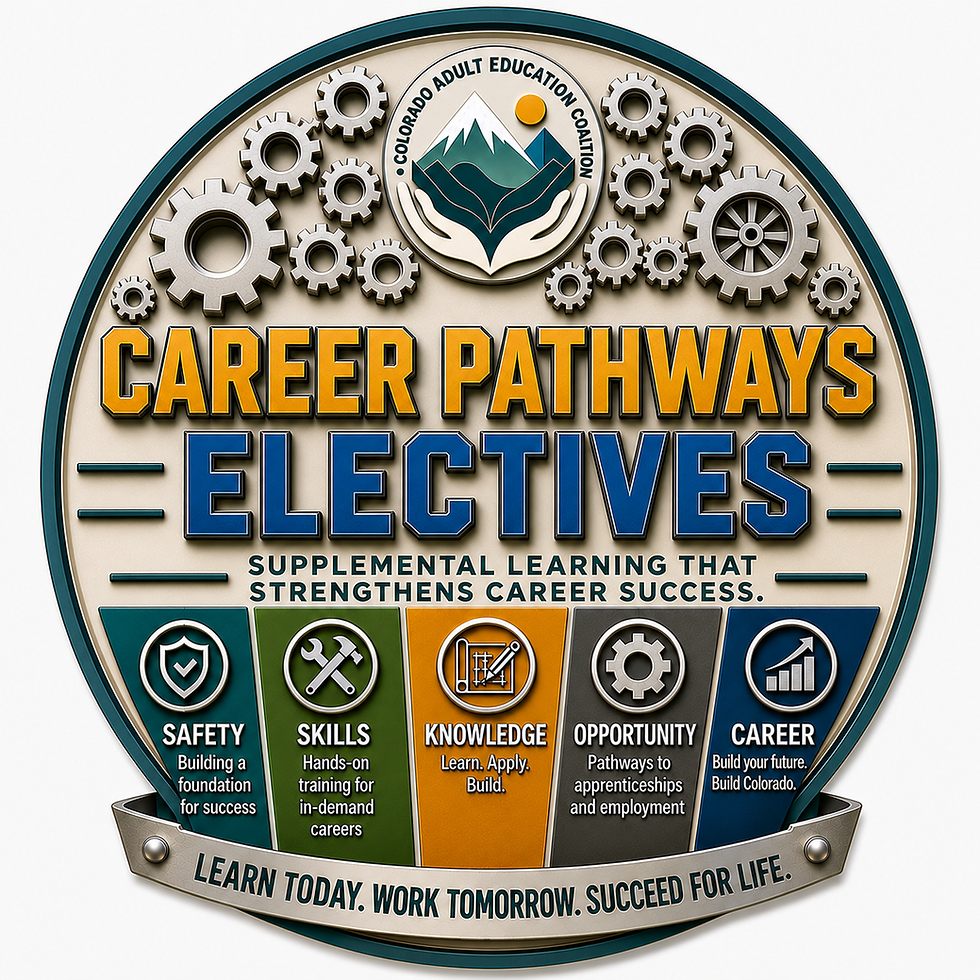
Supplemental learning that strengthens career success.
These short courses, workshops, and learning experiences help participants develop foundational skills that support successful transitions into Registered Apprenticeship, employment, continued education, and long-term career advancement.
Career Pathways Electives
English as a Second Language for the Trades
Students strengthen English skills through contextualized lessons using construction safety, tools, measurements, blueprints, jobsite communication, and workforce-readiness terminology. Students practice speaking, listening, reading, writing, vocabulary, pronunciation, and comprehension using situations they may encounter in construction and skilled-trades workplaces. This ESL course does not provide occupational training for a specific construction trade. Construction topics are used as the context for English-language and foundational-skills instruction. Hands-on occupational training and industry certifications, when offered, are provided separately by qualified training partners.
First Class Begins September 9, 2026
Hurry! Register Today!
Financial Literacy for the Trades
Financial Literacy for Career & Apprenticeship Success is a 4 week CAEC supplemental enrichment class designed for adult learners preparing for employment, Registered Apprenticeship, and career advancement. Participants strengthen practical money-management skills and develop the financial knowledge needed to make informed decisions as they enter and advance in the workforce. instruction is informed by the Financial Literacy component of the North America’s Building Trades Unions (NABTU)/TradesFutures Multi-Craft Core Curriculum (MC3). This course is a supplemental educational offering and does not provide occupational training for a specific trade or occupation. The course is designed to strengthen foundational skills, workplace vocabulary, communication, career readiness, and general knowledge related to the skilled trades. Completion of this course does not qualify, license, or certify a participant to perform work in a specific occupation.
First Class Begins September 12, 2026
Hurry! Register Today!
Artificial Intelligence in the Trades
A CAEC 6 week supplemental enrichment offering that introduces participants to artificial intelligence and emerging technologies affecting construction and the skilled trades. Participants explore applications related to safety, planning, estimating, communication, productivity, and the changing construction workplace. Instruction is informed by North America’s Building Trades Unions (NABTU)/TradesFutures Multi-Craft Core Curriculum (MC3). This course is a supplemental educational offering and does not provide occupational training for a specific trade or occupation. The course is designed to strengthen foundational skills, workplace vocabulary, communication, career readiness, and general knowledge related to the skilled trades. Completion of this course does not qualify, license, or certify a participant to perform work in a specific occupation.

Career Navigation & Support
CAEC connects participants with the tools, experiences, resources, and industry relationships needed to successfully pursue their career goals

Workforce Readiness
-
Employability skills
-
Resume and interview preparation
-
Workplace communication
-
Job search and networking support
Strategic Partnerships
-
Apprenticeship sponsors and unions
-
Employers and industry partners
-
Adult education providers
-
Workforce centers
-
Community organizations
-
State and economic development partners
Employment Readiness & Industry Exposure
-
Employer and industry site visits
-
Union and apprenticeship training center tours
-
Jobsite and workplace observations
-
Employer and Union Representative Guest Speakers
-
Conversations with employers and industry professionals
-
Exploration of high-demand career
Coaching
-
Career and action planning
-
Progress monitoring Barrier
-
and resource navigation Transition and follow-up support.
Workforce Development Partners
-
Adams County Workforce & Business Center
-
Arapahoe/Douglas Works!
-
Boulder County Workforce Boulder County
-
Denver Workforce Services
-
Jefferson County Business & Workforce Center
-
Larimer County Economic and Workforce Development
-
Pikes Peak Workforce Center
-
Pueblo Workforce Center
-
Mesa County Workforce Center
-
Northwest Colorado Workforce Center
-
Rural Resort Region Workforce Center
-
Weld County Employment Services
-
Connecting Colorado (statewide workforce system)
Union Partners
-
International Brotherhood of Electrical Workers (IBEW) Local 68 – Inside Wireman apprenticeship
-
IBEW Local 111 – Lineworker apprenticeship
-
United Association Local 3 – Plumbing, pipefitting, HVAC, and sprinkler fitting
-
Carpenters Local 555 – Commercial carpentry, millwrights, floor covering, pile driving
-
Sheet Metal Workers Local 9 – Sheet metal fabrication and HVAC
-
Operating Engineers Local 9 – Heavy equipment operators and mechanics
-
Bricklayers and Allied Craftworkers Local 3 – Bricklayers, tile setters, terrazzo workers
-
Heat and Frost Insulators Local 28 – Mechanical insulation
-
Laborers' International Union of North America (LIUNA) Local 720 – Construction laborers
-
Iron Workers Local 24 – Structural and reinforcing ironworkers
Adult Education Partners
-
Colorado Adult Education providers
-
Colorado Community College System
-
Emily Griffith Technical College
-
Aurora Community College
-
Community College of Denver
Industry & Apprenticeship Partners
-
Colorado Building and Construction Trades Council
-
TradesFutures (administrator of MC3)
-
Registered Apprenticeship sponsors
-
Associated General Contractors (AGC) of Colorado
-
Associated Builders and Contractors (ABC) Rocky Mountain Chapter
-
Home Builders Association of Metro Denver
Economic Development & Business Organizations
-
Arvada Chambers of Commerce
-
Regional Economic Development Organizations
-
Industry sector partnerships
-
Local employers and employer associations
Community Partners
-
African American Trade Association
-
Pride Initiative
-
Second Chance Center
-
Douglas County Library
-
Denver Public Library
-
Literacy Coalition of Colorado
-
The Master's Apprentice
EXPLORE SKILLED TRADES
Not sure which career is right for you? Explore skilled-trade careers, wages, training opportunities, apprenticeships, and career preparation resources.

YOUTH CAREER EXPLORATION
Find your future in the skilled trades
Built for high school students and recent grads (16–24), plus parents and educators. Explore high-paying trade careers, take a free career quiz, and find apprenticeships and programs near you no four-year degree required.
EXPLORE YOUTH SKILLED TRADES
.png)
.png)
ADULT CAREER EXPLORATION
Your next career is in the skilled trades
Changing careers or leaving the military? Find apprenticeships, training programs, and trade schools near you plus the funding to pay for them. No four-year degree required, just the drive to build something real.
EXPLORE ADULT SKILLED TRADES

.png)
.jpeg)
.png)
EXPLORE MORE...
Not sure which career is right for you? Explore more skilled-trade careers, wages, training opportunities, apprenticeships, and career preparation resources.

Over 649,000 job openings per year in construction and extraction occupations, driven by infrastructure investments, residential buildouts, and an aging workforce retiring out of the trades.
Despite short-term fluctuations in commercial and multi-family residential building, demand for skilled labor (electricians, HVAC, plumbers, equipment operators) remains high due to aging infrastructure projects and ongoing population needs across the Front Range.
High-Demand Roles: Fast-growing specializations include Solar Photovoltaic Installers (+42% projected growth), Electricians (+10%), and Heavy Equipment Operators.
Skilled Shortages: Industry surveys consistently show that over 65–80% of construction firms struggle to find qualified applicants, leading contractors to offer hiring incentives, employer-paid training, and rapid wage increases.

Welding Trade Careers
Infrastructure & Construction: Ongoing regional highway expansion, commercial development, and civil infrastructure projects drive high demand for AWS (American Welding Society) certified structural welders.
Energy & Pipeline Operations: Weld County and Eastern Colorado maintain strong demand for pipe welders across natural gas, oil, and renewable energy sectors.
Aerospace & Advanced Manufacturing: Front Range manufacturing hubs (Denver, Boulder, Larimer County) rely heavily on precision TIG welders working with stainless steel, aluminum, and exotic alloys for defense and aerospace components.
Weatherization Trade Careers
According to the Bureau of Labor Statistics' Colorado employment estimates:
Approximately 1,090 insulation workers (floor, ceiling, and wall) are employed in Colorado.
Approximately 580 mechanical insulation workers are employed statewide.
The average annual wage is approximately $49,830 for building insulation workers and $61,960 for mechanical insulation workers.


Heating, Ventilation, Air Conditioning, Trade Careers
The vast majority of HVAC professionals approximately 70% are employed directly by specialty plumbing, heating, and air-conditioning contractors, while self-employed workers account for about 5% of the market, and wholesale trade and commercial maintenance roles make up an additional 6% combined.
Entering the field typically requires a postsecondary nondegree award, such as a trade school certificate earned over 6 to 24 months, followed by long-term on-the-job training or a formal 3- to 5-year apprenticeship.
Earnings vary noticeably by sub-sector: technicians in wholesale trade ($65,760/year) and educational or government facilities ($60,960/year) command slightly higher average wages than those working in traditional residential contracting ($58,750/year).
Boilermaker Trade Careers
Colorado boilermakers earn an average of approximately $37.46 per hour, or $77,910 annually, with a median hourly wage of approximately $37.53. Entry into the occupation typically requires a high school diploma or equivalent, with most workers developing their technical skills through a Registered Apprenticeship, rather than a four-year college degree.
Nationally, approximately 10,400 boilermakers were employed in 2024, and although employment is projected to decline slightly by 2 percent through 2034, the U.S. Bureau of Labor Statistics projects approximately 800 job openings each year, largely due to retirements and workers transitioning to other occupations.
These workforce characteristics make the boilermaker trade a valuable career pathway for individuals seeking apprenticeship-based training, competitive wages, and employment in construction, welding, fabrication, industrial maintenance, and related skilled trades.


Electrical Trade Careers
In Colorado, Electricians (SOC 47-2111) represent one of the state’s larger skilled construction trades and provide a strong pathway into Registered Apprenticeship and family-sustaining employment.
According to U.S. Bureau of Labor Statistics state occupational data, Colorado employed approximately 16,110 electricians, with a median wage of $29.25 per hour and an average wage of $30.17 per hour, or approximately $62,760 annually.
Electricians typically enter the profession with a high school diploma or equivalent and extensive apprenticeship-based, on-the-job and technical training, making the occupation particularly relevant for individuals pursuing alternatives to a traditional four-year degree.
Opportunities also extend into rural Colorado: BLS reported approximately 260 electricians in Eastern and Southern Colorado’s nonmetropolitan area, with an average annual wage of approximately $62,210.
These workforce characteristics make electrical careers an important component of construction career pathways, offering opportunities in residential and commercial construction, industrial facilities, infrastructure, maintenance, and energy-related projects.
Electrical Wireman Trade Careers
Employment for electrical power-line installers and repairers is projected to grow 7% from 2024–2034, faster than the average for all occupations.
The median annual wage was $92,560 in 2024.
Approximately 10,700 job openings are projected annually because of infrastructure expansion and retirements.

Pipefitters Trade Careers
Statewide Employment: Approximately 10,000+ workers are employed in this occupational group across Colorado, ranking the state 18th nationally in total workforce size for the trade.
Union Presence: Local representation (such as UA Local 208 for Denver/Northern CO and UA Local 58 for Southern CO) offers structured apprenticeship programs, health benefits, and standardized union journeyman wage scales.
Market Drivers: Ongoing commercial expansion, high-density residential development, industrial growth in renewable energy/HVAC infrastructure, and routine maintenance of municipal water and gas lines keep demand high.
Labor Shortages: Pipefitting remains listed among the high-demand skilled trades in Colorado. Due to upcoming retirements and a gap in incoming apprentices, qualified journeymen and specialized pipefitter-welders often command premium pay and overtime opportunities.
Painting Trade Careers
Covered Employment: 3,700 painters are directly employed on payrolls in Colorado. (Note: Total active painters including self-employed subcontractors is estimated at 5,000 to 5,500).
Rank in Construction: Painters are the 8th largest trade group in Colorado by overall headcount.
Concentration Hotspot: Northwest Colorado (resort towns including Steamboat, Vail, and Aspen) has one of the highest concentrations of painters in the nation (Location Quotient: 2.81 vs. the U.S. baseline of 1.0) due to high-end residential repaints and harsh mountain weather maintenance.


Drywall Finishing Trade Careers
Statewide Employment: Approximately 1,560 to 1,900 drywall and ceiling tile installers/finishers are employed across Colorado.
Statewide Concentration: Colorado’s wage rates for drywall mechanics sit about 3% below the national average, though demand remains steadily elevated due to ongoing commercial and residential construction along the Front Range.
Industry Representation: A significant portion of commercial drywall finishers in Colorado are represented by the International Union of Painters and Allied Trades (IUPAT) District Council 81, while residential work remains predominantly non-union/subcontractor-based.
Glazing Trade Careers
Statewide Employment: Approximately 1,440 to 1,720 active glaziers are employed in Colorado.
Job Concentration: Colorado has a high concentration of glaziers relative to national averages (a location quotient near 1.45 to 1.78), driven by high-density commercial growth along the Front Range.
National Job Outlook: Glazier positions nationwide are projected to grow by 3% through 2034, keeping pace with standard construction growth.


Sheet Metal Trade Careers
Total Employment: Approximately 1,600 to 2,070 sheet metal workers are employed statewide in Colorado.
Workforce Share: Sheet metal workers account for roughly 0.57 to 0.73 jobs per 1,000 overall jobs in Colorado.
Demographics: Statewide, the trade mirrors national trends where over 68% of sheet metal workers are employed directly in building construction and mechanical contracting.

Elevator Mechanic Trade Careers
The apprenticeship generally lasts 4 to 5 years and includes:
Approximately 8,000 hours of paid on-the-job training
100–200 hours of classroom instruction each year
Wage increases as skills improve
Eligibility to become a licensed mechanic after completing training and passing the mechanic exam
Median annual wage: $106,580
Median hourly wage: $51.24
Apprentices usually begin at about 50% of a mechanic's wage, with scheduled increases throughout the apprenticeship.
Colorado supports approximately 5,000 cement masons and concrete finishers and roughly 700 plasterers and stucco masons, demonstrating an established workforce of nearly 5,800 workers across these related trades.
Cement masons and concrete finishers earn approximately $60,000 annually on average in Colorado, with employment concentrated in major construction markets including the Denver metropolitan area and Northern Colorado.
These occupations provide accessible skilled-trade pathways into commercial construction, concrete finishing, infrastructure, plastering, stucco, restoration, and related construction careers, with apprenticeship and work-based training providing alternatives to a traditional four-year college pathway.

